

Hotel guestroom inspections and public-area rounds need different routes, but the same discipline: inspect the actual condition, record what needs attention and verify the handback. A tidy room is not automatically ready for release, and a polished lobby is not proof that every guest route is clear.
This guide gives hotel teams a practical walkthrough for guestrooms and shared spaces. Adapt it to current brand requirements, property procedures, access rules and local obligations. It is not an official rating checklist, a technical equipment inspection or a substitute for specialist safety checks.
1. Set the Scope Before Hotel Guestroom Inspections
Confirm the room or area, inspection purpose, authorized access, responsible team and decision owner. A post-cleaning room release, an occupied-room concern, a planned quality review and a maintenance handback are different jobs. Do not treat access to one as permission for another.
Use the current property checklist and record its version. The AA Hotel Quality Standards address bedrooms, bathrooms, maintenance and public spaces within the AA scheme. Those criteria are a useful example of breadth, not a universal brand standard. A property’s actual requirements decide what must be checked.
Before entry, check room status and follow the hotel’s privacy, security and entry procedure. Keep guest names, belongings and personal information out of routine photographs. If access is unavailable, record “not inspected” and arrange the next authorized opportunity rather than assuming the room meets the standard.
2. Use a Consistent Route for Hotel Guestroom Inspections
For hotel guestroom inspections, use a repeatable route so attention does not stop at the bed. A published operator room-inspection SOP uses entryway, bedroom, bathroom and additional spaces, followed by documentation and final approval. Its 2024 procedure is a property-specific example; adapt the route rather than copying its settings or presentation details.
- Entry and first view: note visible soil, door and frame condition, supplied guest information and any unusual odor. Report a lock or security concern through the authorized process; appearance alone does not confirm correct operation.
- Bed and soft furnishings: check linen presentation and visible condition, accessible upholstery surfaces, curtains and furnishings against the property standard. Separate removable soil from tears, wear or damaged fittings. Do not move heavy furniture or dismantle a bed outside the approved task and training.
- Floors and accessible edges: look for debris, spots, loose edges, damaged transitions and missed areas within the inspection’s safe reach. Record the exact location rather than writing only “carpet dirty.”
- Bathroom: review visible condition of fixtures, mirrors, counters, flooring, grout and supplied items. Record residue, hair, standing water, leaks or damaged fittings separately. An apparent cleaning issue may need maintenance assessment.
- Fixtures and guest-use items: complete only the functional checks covered by the property’s procedure and the inspector’s training. Refer electrical, HVAC, plumbing and other technical concerns to the responsible qualified person.
- Additional spaces and final view: include closets, connecting areas and outdoor spaces only where present and authorized. Recheck the room status, outstanding findings and release decision before handing the room back.
The Turks and Caicos accommodation checklist also separates bedrooms, bathrooms and public areas. It illustrates why one quick glance is insufficient, but its local inspection scheme and scoring do not apply to every hotel.
3. Prepare Public Areas Around the Guest Route
Public spaces remain in use while teams inspect them. Define the route and arrange access with operations before starting. Include entrances, lobby seating, reception surroundings, corridors, lift lobbies and public restrooms that fall within the agreed scope. Check planned events, deliveries, weather-related conditions and active cleaning or repairs so the walkthrough reflects current use.
Entrances and circulation
Review mats, flooring, transitions, visible soil and water tracking. Look for luggage, carts, cables or event furniture obstructing circulation. Observe the required accessible and emergency routes against the property’s procedures; a housekeeping round does not certify legal accessibility or fire compliance. Escalate an urgent concern immediately through the hotel’s response process rather than leaving it for the end-of-round report.
Seating, reception and shared finishes
Check accessible upholstery, tables, counters, glazing and decorative surfaces for soil, damage and incomplete work. Review the presentation from the guest’s likely position as well as the main approach. Record a damaged chair separately from a spot on its upholstery so cleaning does not accidentally close an unresolved repair issue.
Public restrooms and service handoffs
Arrange inspection access without compromising guest privacy. Check visible cleanliness, supplies, waste, floor condition and signs of leakage or damage within the approved scope. Record any restricted facility and confirm who communicates its status. Coordinate with housekeeping, engineering or the duty manager when the correction crosses team boundaries.
Do not choose a universal round frequency from this article. Set timing from the property’s requirements, traffic, events, known issues and actual conditions. The high-traffic hotel cleaning guide explains how to connect peak-use conditions with planned work and handback.
4. Keep Inspection Findings Separate From Treatment Decisions
An inspector can identify a visible condition without prescribing a chemical or repair. Record the surface and location, then confirm the material, care instructions and suitable scope before treatment. The Carpet and Rug Institute advises following cleaning-product directions and pretesting. The Natural Stone Institute explains that stone composition affects cleaner suitability and that acids can damage sensitive stone.
Do not use extra product, aggressive scrubbing or a generic descaler simply to remove a finding before review. Where the cause or material is unclear, obtain the appropriate assessment. For deciding how to classify and close a finding, use the hotel inspection deficiencies guide.
Inspection and correction must stay within staff training. OSHA’s cleaning-industry guidance identifies chemical, equipment and physical-environment hazards. Follow the hotel’s applicable safety procedures and local requirements; this guide does not authorize hazardous access, equipment testing or technical repairs.
5. Record Hotel Guestroom Inspections and Area Handbacks Clearly
Give each finding enough detail for another team to act without guessing. A useful record includes:
- Room or exact public-area location, date, inspector and applicable requirement.
- Observed condition, supporting evidence and anything that could not be inspected.
- Accountable owner, approved correction, access dependency and due date.
- Interim status or controls under the property’s procedure.
- Acceptance criteria, person who rechecks and final room or area status.
For example, a corridor inspection finds a carpet spot and an adjacent raised edge. Create distinct findings. Cleaning may address the spot, while the edge needs the appropriate maintenance assessment and control. Do not close both because a cleaning invoice arrived.
6. Recheck Before Release and Learn From Repeats
After hotel guestroom inspections or public-area rounds, compare completed work with the original finding and acceptance criteria. Record what remains unresolved. The authorized decision owner should confirm room release or area handback under the property’s procedure, including any continuing restriction. “Work completed” and “accepted for use” are not interchangeable statuses.
Review repeated findings by location and condition. They may indicate a gap in access, method, training, maintenance or task timing, but repetition alone does not establish the cause. Use the hotel QA inspection readiness guide to connect walkthrough records with a wider preparation checklist.
Plan Specialist Cleaning With a Defined Scope
If hotel guestroom inspections or public-area rounds identify work beyond routine housekeeping, contact Renue Systems or find your local team. Share the area, material, observed condition and available access window. Agree on the cleaning or restoration scope and handback criteria. Specialist cleaning does not certify brand compliance or guarantee an inspection score.
Return to the Hospitality Resource Center for related planning guides.
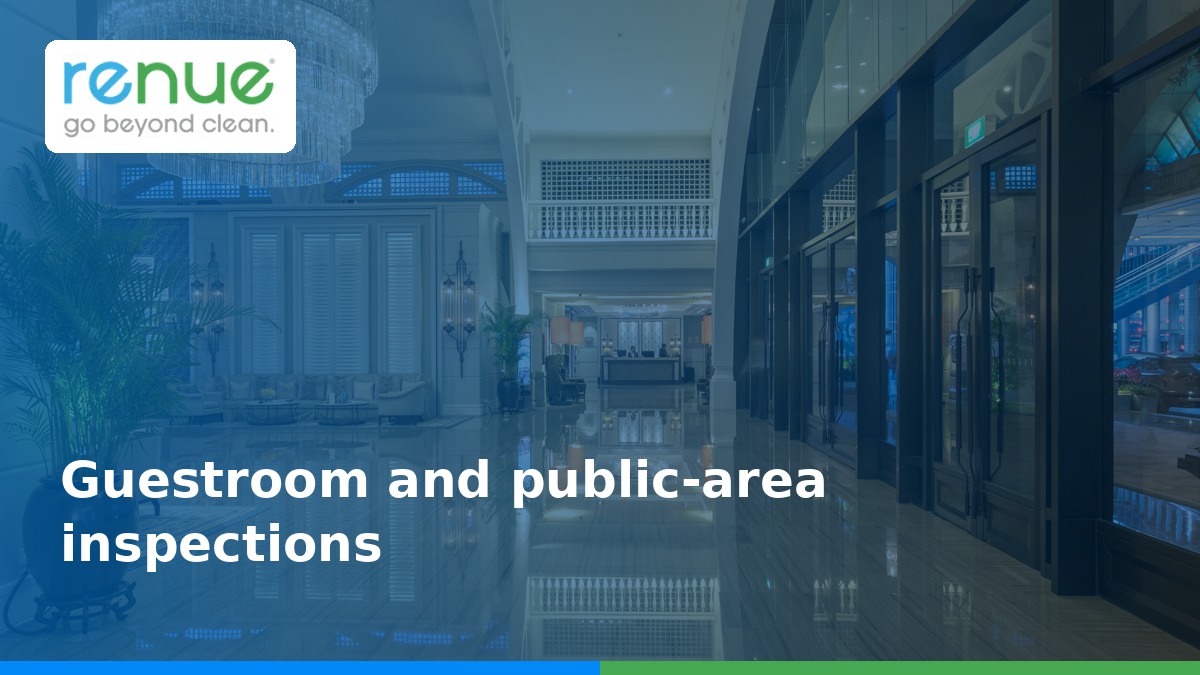
Illustrative photo: Reception hall with reflecting floor and chandelier at The Fullerton Bay Hotel Singapore by Basile Morin, CC BY-SA 4.0. Cropped, color-adjusted and overlaid with Renue branding and text. This adapted image is shared under the same CC BY-SA 4.0 license. Pictured property is illustrative, not a claimed client.
