

Hotel PTAC cleaning belongs in a documented maintenance program, not a last-minute response to a complaint. A packaged terminal air conditioner needs product-specific care, clear responsibility and a record of what was checked. A clean-looking front cover is not evidence that the whole unit is ready for service.
This guide explains why cleaning matters, how to avoid planning mistakes and how to build a maintenance schedule. It is for hotel managers coordinating work, not a procedure for opening, washing or repairing equipment. Interior service, electrical work and refrigerant work require the qualifications and precautions specified for the installed unit.
1. Identify the Equipment Before Planning Hotel PTAC Cleaning
Record the room, asset number, manufacturer, model, serial number, relevant accessories and current manual. Note who maintains the unit and where its service history is kept. Do not assume every through-wall or room air conditioner is the same type of equipment.
Amana’s product catalog distinguishes PTAC, through-the-wall, vertical terminal and window products. Its literature library provides a route to product documentation. These are identification resources, not a claim that the hotel uses Amana equipment or that one manual applies to another model.
Match the installed equipment to its current instructions before defining the task. If the record is incomplete or the model cannot be confirmed, leave that item open for the responsible supplier or qualified service team. A familiar cabinet shape does not settle cleaning methods, filter compatibility or ventilation features.
2. Understand Why Hotel PTAC Cleaning Matters
Manufacturer maintenance instructions address more than appearance. The Friedrich FreshAire PTAC installation and operation manual, whose retrieved revision is dated October 2026, covers filters, coils, base pan, sleeve, drainage and other components. It separates filter maintenance from interior service reserved for trained personnel.
The management lesson is to confirm which components the proposed scope actually covers. Cleaning the decorative front, maintaining a filter and servicing the interior are different tasks. A work order that says only “clean PTAC” leaves the completion standard unclear.
For the wider building, the EPA’s Managing Buildings for Good IAQ guidance describes preventive maintenance, appropriate equipment records and attention to components exposed to water. This is historical commercial-building guidance from the 1991 Building Air Quality guide, not a current PTAC service specification or code.
Use these sources to support a planned care process, not a promise of a particular energy saving, equipment lifespan or health outcome. A maintenance visit also does not establish that a unit is correctly sized, properly installed or free of technical faults.
3. Avoid Hotel PTAC Cleaning and Maintenance Mistakes
- Calling a cover wipe a complete service. Define the components included, the personnel responsible and the findings that need a separate work order.
- Using one method across all models. Confirm the installed product, approved process, material compatibility and safety requirements before work starts.
- Assigning interior service as ordinary room cleaning. The retrieved Friedrich manual reserves interior work for HVAC technicians and warns about electrical hazards. The responsible service team must determine safe isolation and the required competence for the actual unit.
- Treating an odor, dust report or poor cooling as a diagnosis. Record the observation and refer it for assessment. Repeated cleaning does not prove the underlying cause has been addressed.
- Leaving drying, reassembly and handback undefined. Confirm applicable product requirements and the authorized return-to-service checks. Do not infer readiness from a fixed elapsed time.
- Closing the task without a record. Identify the unit, work completed, exceptions, responsible person and next action. A batch invoice alone may not show which rooms still need attention.
These are planning failure modes, not a ranked survey of the most common hotel mistakes. This article does not authorize chemical treatments, pressure washing, component removal or changes to controls. Resolve those details with the manufacturer and appropriately qualified team.
4. Build a Product-Specific PTAC Maintenance Schedule
Separate each task in the register: filter care, external checks, qualified interior inspection or cleaning, drainage-related assessment where applicable, and follow-up for recorded findings. For each task, capture the source instruction, starting interval or trigger, responsible team, access needs and completion evidence.
The retrieved Friedrich manual illustrates why one interval is insufficient. For that product, it specifies filter cleaning at least monthly, more often if conditions warrant, while other components have different inspection instructions and condition-based cleaning needs. Those are model-specific examples, not a universal hotel calendar. Confirm the exact current manual for the installed unit rather than copying this example into every room’s schedule.
Use room and unit history to discuss whether the plan needs adjustment with the responsible technical team. Record recurring findings, changes in use, nearby renovation dust or other relevant operating conditions. An urgent fault is not deferred until the next routine cleaning slot, and an early visit does not silently reset every other task.
Connect the plan with the hotel preventative maintenance calendar and the maintenance budget process. Confirm measured unit counts, scope, room access, labor assumptions and exclusions before comparing quotes. Keep technical repairs visible as separate findings where they are outside the cleaning scope.
5. Keep PTAC Care Inside a Wider Indoor Air Quality Plan
The EPA’s office-building occupant guide describes indoor air quality as an interaction of pollutant sources, ventilation-system design and operation, moisture and other factors. Its office context does not make it a hotel operating standard, but the distinction matters: equipment cleaning alone is not a complete indoor air quality assessment.
The Florida Green Lodging indoor air quality guidance recommends a written plan, HVAC maintenance logs and attention to moisture and airflow obstructions. It is a 2020 lodging-program resource. Its generalized filter or frequency recommendations should not override the compatibility and maintenance requirements of a particular PTAC.
If a complaint recurs, record its location, time, reported conditions, related work and who will assess it. Keep room housekeeping, building moisture, ventilation and technical equipment findings connected rather than assuming the PTAC is the only possible source. Do not describe visible discoloration as a confirmed contaminant or use cleaning completion as a medical assurance.
The guestroom inspection guide can help organize a wider walkthrough. It does not replace an HVAC inspection, indoor air quality investigation or the property’s emergency procedures.
6. Verify Hotel PTAC Cleaning Completion and Follow-Up
Agree on the handback record before the visit. It should identify each unit, the approved scope, work performed, required checks by the responsible personnel, unresolved findings, restrictions and the next due task. Record actual completion rather than marking every unit done because a team visited the floor.
For example, a technician completes the planned work in one room but identifies a separate drainage concern. The cleaning task and the drainage finding should have different closure evidence. Management can track access and follow-up without turning a housekeeping checklist into technical approval.
Compare the next inspection with the previous condition and service record. Repeated findings may justify reviewing scope, access, timing or technical causes with the appropriate team. They do not, by themselves, prove equipment failure or justify replacement. Use the asset condition record and preservation versus replacement framework to keep that decision evidence-based.
Discuss a Hotel PTAC Cleaning Plan
For hotel PTAC cleaning support, contact Renue Systems or find your local team. Share the equipment register, current manuals, service history, unit counts and room-access windows. Confirm the local team’s available scope and any separate technical service needs before scheduling work.
Return to the Hospitality Resource Center for related hotel maintenance guides.
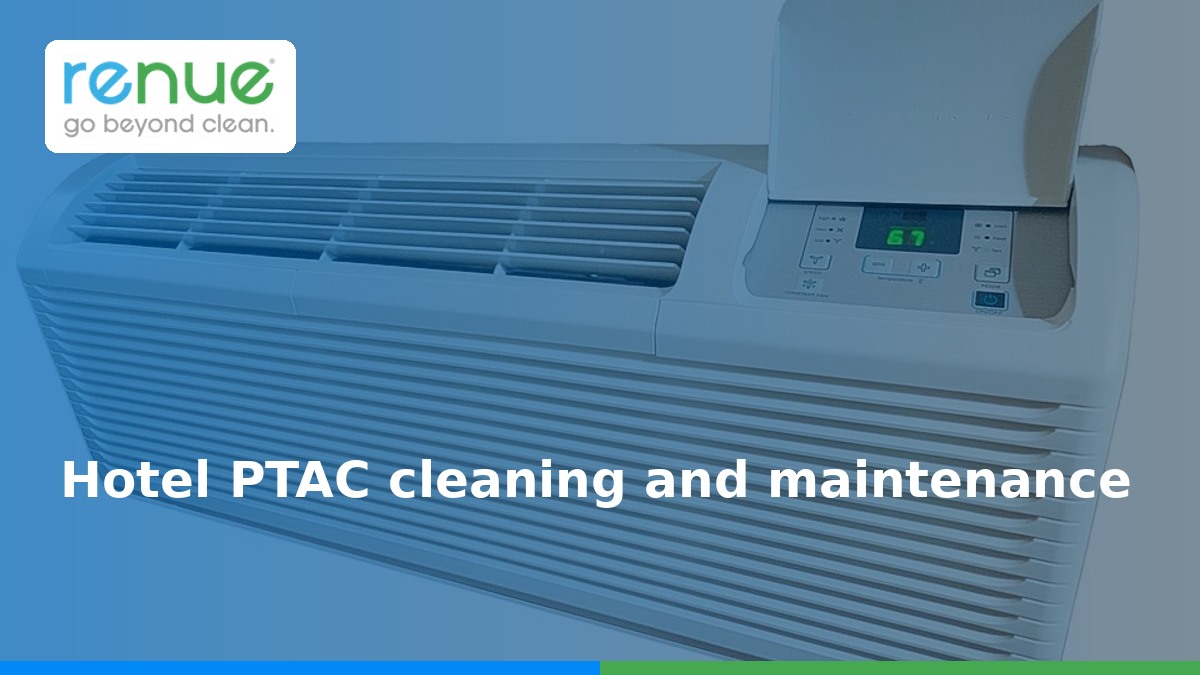
Illustrative photo: Packaged terminal air conditioner photographed in a Texas hotel in April 2026 by Nhfruchter, CC0 1.0. Cropped, color-adjusted and overlaid with Renue branding and text. Not a claimed client installation, product endorsement or verified current equipment condition.
